Artificial intelligence in business
AI for business: the 4 levels, from ChatGPT to the 2030-ready company
An SME or a mid-sized company can bring in AI at four levels: ChatGPT or Claude licences for its teams, automations between tools, the AI built into off-the-shelf software, or AI-native internal software that it owns. Only the fourth puts AI to work on all your business data: that is what C-Esium builds, from AED 200,000, with AI built in from the first version. To start smaller, a focused project — for example an AI connector on your current tools — starts from AED 40,000.
The 4 levels of AI in a company
Each level has its place. What sets them apart is what the AI can access: the more real business data it reads, the more useful it is — and the more the tool that holds that data matters.
| Level | What it is | Indicative cost | Gains | Limits | For whom |
|---|---|---|---|---|---|
| 1. AI licences (ChatGPT, Claude) | Subscriptions to a conversational assistant: writing, summaries, translation, analysis of the documents you give it. | Low: a monthly subscription per user. | Individual time savings on writing, immediate take-up. | No access to your business data; everyone copies and pastes; uneven use, with a risk of sensitive data in personal accounts. | Every company, as a first step. |
| 2. Automations (Zapier, Make, n8n) | Scenarios that connect your existing tools and add an AI step: sort an email, summarise a form, create a task. | Low to moderate: a subscription to the tool, often based on volume, plus design time. | Less copy and paste between tools; quick results on well-defined repetitive tasks. | Fragile when a tool changes; often maintained by a single person; the data stays scattered; a badly designed process stays badly designed. | Small scopes, simple flows between two or three tools. |
| 3. AI in off-the-shelf software (SaaS and ERP copilots) | AI features added by the vendor to your CRM, your ERP or your business software: summaries, suggestions, a built-in assistant. | Moderate: often an option or a higher plan, charged per user. | AI right inside the work tool, with no integration to build. | Limited to the vendor’s scope and data model; one assistant per software; you follow its roadmap. | Companies whose processes fit into one or two standard software packages. |
| 4. AI-native internal software that you own | Management software built around your processes — CRM, quotes, jobs, scheduling, invoicing, reporting — with AI plugged into all your data. | An investment: from AED 200,000 at C-Esium (from €50,000 in France), firm quote after scoping, no per-user licence. | A single source of truth; AI writes, answers and alerts on your real data; it can be queried from ChatGPT or Claude. | A focused V1 in 1 to 2 months, a complete system from 6 months to more than a year; an internal project lead is essential. | SMEs and mid-sized companies in every sector with specific processes, several sites or field teams. |
The levels add up
The trap of levels 1 and 2
Between levels 2 and 4, a focused project, from AED 40,000, lets you start with one piece: an AI connector to query your current tools from ChatGPT or Claude without changing software, automations between your tools, a single module or a mobile app for field teams. The focused project.
Where to start? With the journey of a case, not with the tool
The right question is not “which AI tool should we choose?” but “where does my company lose time and margin?”. The answer is found in the field, by following a case from end to end.
Five questions to ask yourself before choosing
- How many times is the same piece of information entered between the customer’s call and the invoice?
- How long does it take between the end of a job and the invoice being sent?
- Who chases quotes, and from when?
- Which tools have your teams abandoned for a spreadsheet, a notebook or sticky notes?
- Does your management know the margin on a deal without waiting for the end of the month?
The C-Esium assessment
A half-day workshop, on site or by video. We follow the real journey of a case, from the incoming call to the invoice: tools used and abandoned, human friction, and where the lost margin hides — re-keying, waiting, errors, reminders.
You then receive a scoping document: a map of the current journey, friction quantified in time, the target scope, integrations, a roadmap by phases and a firm quote, not a range.
First contact: a 30-minute call, free and with no commitment.
Why your data and your tool matter more than the AI model
The most advanced models are available to every company, by subscription or through an API. What makes the difference is what the AI can read: structured, up-to-date, connected data.
When quotes live in a spreadsheet, jobs in a notebook and hours on paper, the AI has nothing reliable to read. It can write an email; it cannot tell you which deals are going off track.
Your internal software is your system of record, and it belongs to you. AI is the layer of intelligence plugged into it.
What AI does when it works on your real data, from V1 at C-Esium:
- it writes most of the job reports from the technicians’ voice notes;
- it answers on the real business, through a copilot: “Where does site X stand?”;
- it answers from Claude, ChatGPT or the app’s chat, through a read-only, logged MCP connector.
Because you own the code, the database and the documentation, you depend neither on a software vendor nor on a model provider: MCP is an open standard, supported by Claude as well as ChatGPT. How the connector works.
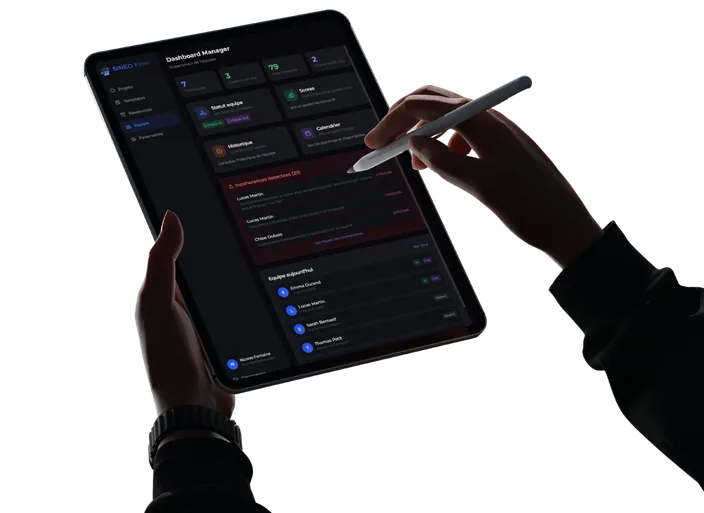
Using AI, or being 2030-ready
The question is not whether your teams use AI, but what the AI can work on: a few documents pasted into a chat, or the real data of your business.
Using AI or being 2030-ready
The pitfalls that make an AI project fail
Most often, it is not the technology that makes a project fail, it is the organisation. That is why change management, led at C-Esium by Cyrille Fantino, partner, interim manager and consultant, is part of the method, from the build to after delivery.
Automating a broken process
AI speeds up whatever you give it, bad habits included. A pointless approval loop, once automated, is still pointless.
What we do: map the current process and the target process, find the organisational bottlenecks and write down the business rules before writing a single line of code.
Poor input data
An AI that reads incomplete records or statuses that are never updated gives wrong answers, stated with confidence.
What we do: a single entry, the right fields at the right moment, business rules built into the tool: data quality is built at the source, in the field.
Resistance and workarounds
Double entry, a parallel spreadsheet, sticky notes: if the tool does not make the work simpler, teams work around it and the data dries up.
What we do: meet every profile — those happy with the current tools, those who work with sticky notes, those who have had enough — and rely on internal champions and short working groups with immediate deliverables.
Unanticipated human impact
A role that changes, a task that disappears, a check that becomes visible: if ignored, these effects block adoption.
What we do: redesign of the approval circuits, adjustments between the organisation and the solution after go-live, consolidation of procedures, then a review and a handover of autonomy.
AI and data: what you should require
Putting AI to work on your data does not mean handing it over without control. The rules C-Esium applies:
Read-only, authorised and logged access
Business plans
Health and social care, a separate case
A real case: Tech-O, level 4 in production
Estimate made by C-Esium with Tech-O, across field work, organisation, accounting, payroll, HR and management.
Frequently asked questions
Where should an SME or a mid-sized company start with AI?
With your processes, not with the tool: find where your company loses time and margin — re-keying, waiting, errors, reminders — before choosing a technology. At C-Esium, it starts with a free 30-minute call, then a half-day assessment workshop, on site or by video, that follows the real journey of a case, from the incoming call to the invoice.
Are ChatGPT or Claude licences enough to bring AI into the business?
They save time on writing, but the assistant has no access to your business data: quotes, jobs, invoices, schedules. For AI to work on your real business, you need structured data in a tool it can connect to — for example internal software with an MCP connector, like the ones C-Esium delivers from the first version.
How much does it cost to bring AI into a company?
It depends on the level: a monthly subscription per user for licences; a subscription plus design time for automations; often a paid option for the AI in off-the-shelf software. At C-Esium, a focused project — for example an AI connector on your current tools — starts from AED 40,000, and AI-native internal software from AED 200,000, excluding VAT (from €10,000 and €50,000 for clients in France). The price is set in a firm quote after scoping, with no per-user licence.
What is a 2030-ready company?
C-Esium calls “the 2030-ready company” a company whose software, data and processes let AI work on its real business — without depending on a software vendor. Being 2030-ready means going beyond individual use of AI tools: the AI works on the company’s own data, inside software the company owns.
Is our data used to train ChatGPT or Claude?
Not with the business plans C-Esium recommends: according to OpenAI and Anthropic, ChatGPT Business and Enterprise, Claude Team and Enterprise and their APIs do not use company data to train their models by default. Assistants access your software read-only, only for the users you authorise, every access is logged, and this framework is set out in the contract.
Further reading
Query your data from ChatGPT or Claude
The MCP connector explained: what it allows, what leaves your software, which plan to choose.
ReadCustom internal software: offer, pricing, timelines
What you get, from AED 200,000 — or from AED 40,000 for a focused project — and what belongs to you at the end of the project.
ReadSoftware and AI assessment
Place your company and get a first recommendation, before you even call us.
ReadSources
Official sources, accessed 4 October 2026.
Where does your company stand on the 4 levels?
30 minutes to place your company, spot where AI would save time on your real data and see whether internal software is justified — or whether a focused project is enough. Free, with no commitment.